Future of Artificial Intelligence
While Artificial Intelligence (AI) has made tremendous progress in the recent past, it is nowhere near accomplishing its original goal of matching human intelligence. A lot of research is still going on in this area and we may see more success in the coming years. However, even if no new capabilities are invented, just deploying existing capabilities across business and consumer space may take another decade, improving quality of life significantly.
Let’s consider the future direction of AI developments.
Expanding AI Horizons
A recent McKinsey report “Notes from the AI frontier: Applications and value of deep learning” indicates that about 16% of analytical applications can only be implemented with Deep Learning (DL) techniques, where currently available Machine Learning (ML) techniques cannot help. About 69% of applications can improve their performance, if current ML/ statistical analysis algorithms are replaced with deep learning algorithms. Most of the recent success in AI is due to developments in DL, and within that it is Supervised Learning that has proven successful in commercial applications. The applications are mostly in computer vision, speech recognition and Natural Language Processing (NLP) areas using image, audio and text data. AI’s penetration into traditional business enterprises at this stage is limited to very few areas like customer support.
Reinforcement Learning has also made tremendous progress, but is limited to only games like AlphaGo, Chess etc. as of now. Some of these learnings may be used to solve enterprise business problems in future.
Unsupervised Learning is currently playing a complimentary role to Supervised Learning. In future, we may see it solving critical problems directly.
Penetration into Enterprise Space
Following is the list of potential AI applications that can gain traction in the consumer as well as enterprise space. Apart from these applications, DL can penetrate into traditional ML applications using enterprise structured data.
Predictive healthcare
Predicting patient outcomes based on his/her medical records can help save many lives and reduce the cost of healthcare significantly. Google is doing lot of research in this area, and already doing a few field trials on using retina images to predict cardiovascular risk, Age, Gender, smoking habits, HbA1c, blood pressure, Body Mass Index(MSI) etc.
IBM also has invested a lot in this space, an mainly on their Watson technology. Using CT scan and MRI images, Watson helps predict cancer well in advance so that it can be cured.
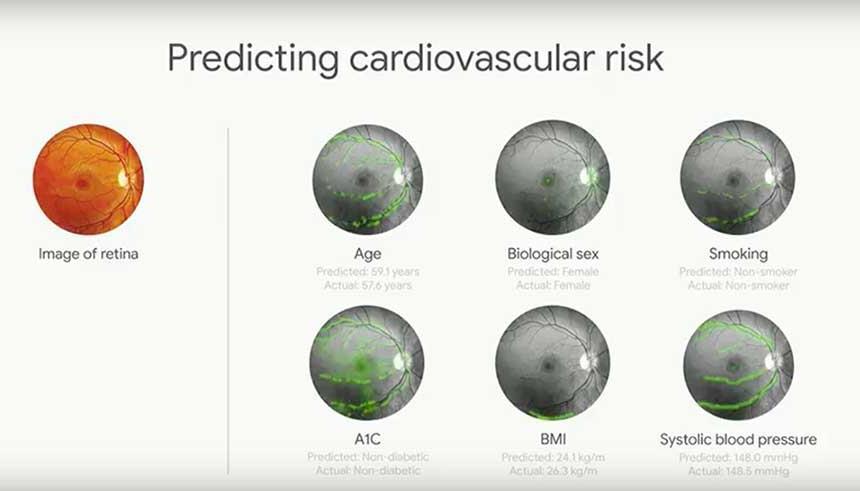
Predicting Cardiovascular Risk
Behavioral targeting
By mapping a set of website attributes with data, one can predict how long a user will spend on the website. Google search engine, YouTube and all e-commerce sites use this to predict which advertisements would be more appropriate for a given user and present those advertisements. One can also predict the probability of the user making a purchase on e-commerce site
Smart reply
Google Mail already has a feature that provides one-line replies automatically based on the e-mail content. Google is further expanding it to “smart compose”, to compose a complete reply by suggesting relevant sentences based on few characters/words typed in the beginning of sentence. This is similar to suggestions we get in search engines.
Board game AI
This is the ability to predict next player move based on current board position in games like chess and Go. These AI powered computer games have defeated world champions in respective games. IBM and DeepMind (now owned by Google) are spearheading research in this area.
Product quality control
Mapping a set of attributes relative to an instance of a manufactured product with the probability that the product will fail by next year.
Weather prediction
Mapping time series of weather data in a grid of locations to predict weather data for the following week at a specific location.
Diet helper
Predicting calorie count based on pictures of food.
Age prediction
Predicting the age of the person by using his/her selfie image
Logo generation/selection
Mapping the name and description of a company to the company’s logo
Visual depth sensing
Mapping images of indoor environments to maps of depth predictions
Visual QA
Mapping images and natural-language questions about the contents of images to natural-language answers
Video QA
Mapping short videos and natural-language questions on the video content to natural language answers
Intelligent Enterprise
Latest developments in NLP such as chatbots and digital assistants are changing the human-machine interface significantly and could have a major impact on enterprise business applications that currently use a Graphical User Interface (GUI) for all user inputs. While GUI itself is undergoing phenomenal changes to improve user experience, text or voice-based interfaces can further enrich user experience dramatically.
These new interfaces could open up new channels of interaction between users and enterprise through social media sites like Facebook, WhatsApp or other messaging platforms such as Slack and Skype.
GUI is more of a one-way procedural input and does not have any built-in intelligence. On the other hand, digital assistants and chatbots are conversational, enabling natural interaction between users and applications – just like the interactions between two human beings. This can make business applications more context aware, intelligent and responsive to customers in real time. Hence, most existing GUI interfaces could be replaced with these conversational interfaces going forward.
Cognitive Process Automation (CPA) developments can make underlying business processes more intelligent and smart. They can be made adaptive to external changes or self-healing in case of failures. Existing processes will be reengineered to make use of CPA technologies.
Historically, business operations applications and business intelligence/analytics applications have been developed in two different silos. With these new AI developments, boundaries between these two silos can collapse, and there could be seamless integration of these two sets of applications.
All these developments could have a major impact on the business/IT architecture including infrastructure, application and technology architectures. AI developments can offer smarter security solutions to safeguard against increased security risks on infrastructure, data and user privacy, as well as vulnerability towards external hacking.
Finally, platforms like IBM Watson, Salesforce Einstein can enable implementation of these intelligent applications, making enterprises smarter than what they are today.
Multi-model problems
Typical DL problems involve one type of data input such as structured data, image/video, text, or audio, with the output also in one of these formats. However, Deep Learning algorithms allow use of multiple such inputs at the same time, as well as output multiple such data types. These are called multimodel problems.
If an online apparel retailer decides to store product information in a traditional attribute form, along with a verbal description of the item, and its image, there are three forms of input available. In this scenario, a multimodel architecture can be built to take all three forms of input and predict the price and/or the demand (in number of units). This helps improve the accuracy of the prediction as more information is taken as input. This will also make it easy for customers to search for products that they are looking for, thereby improving customer experience.
Brain Computer Interface
Man-machine interfaces have evolved from punch cards, keyboard, mouse, touchscreen, and being voice controlled, to being motion/gesture controlled over time. There is also ongoing research to develop thought-controlled interface to machines, connecting brain to machine directly. Many leading technology companies are investing in this space.
Elon Musk has started a company called Neuralink with highly ambitious goals such as:
- Creating new implants that can be surgically inserted into the human brain
- Allowing humans to mentally interact with the devices around them
- Allowing humans to amass data via the chip
- Helping medical practitioners treat more injuries
Essentially, Musk is trying to create a Brain Computer Interface (BCI), where the human brain directly interacts with various computing devices.
In April 2017, Facebook also announced that they are developing BCIs for typing and skin hearing. BCI for typing enables the brain/mind to type thoughts directly into a text file, without hands/keyboard. Similarly, BCI for skin-hearing enables deaf people to hear through their skin.
We know that devices like pacemakers and stents are implanted in the human body to cure some chronic diseases. But the devices that Facebook is developing don’t need to be implanted but can be worn just like any other wearable devices.
Designing Deep Learning Models
As we have seen, there is a paradigm shift from traditional programming to ML models. However, by combining both the approaches one can improve the potential of DL to overcome many of the current limitations.
Memory Networks have already taken a small step in this direction. In order to answer questions that involve multiple sentences/phrases, memory networks go back and forth in between the layers, a process called multi-hop processing. These essentially, bring in features of traditional programming like loops, i/o, and exception handling into the layered process of Deep Learning.
This approach could gain momentum in future and more innovations can be expected to solve problems that are not possible to solve today. It can also help modularize the design of complex Deep Learning, model and pave the way for automated machine learning (AutoML).
Art of Data Science and its automation, AutoML
Terms like Data Science, Neural Networks, Deep Learning are misnomers in the sense that their names don’t suggest what they really do.
The term Data Science was coined by Harvard in their article titled “Data Scientist: The sexiest job of 21st Century”, to represent Machine Learning, extending to Deep Learning.
Deep Learning got its name based on the depth of the model in terms of number of layers, and not based on its real feature of layered representation learning. Neurons in Deep Learning are a simplistic approximation of neurons in the brain, but don’t really have the same behavior. The way Deep Learning models are designed, they don’t form a network, but are arranged in successive layers from input to output in a sequential manner. In that sense, neural network is also a misnomer. To make a large Deep Learning model work, several parameters need to be tuned, which are called hyperparameters. They are not model parameters to be learned, but to be pre-decided by the designers of the model.
Hyperparameters include type of model (Dense, RNN, CNN or their variants), number of layers, number of neurons/filters in each layer, activation function to be used in each layer, learning rate and other optimization parameters, type of regularization and associated parameters, etc.
Only when we get all these hyperparameters right, can we get an optimal solution. While there are some guidelines to help us choose these parameters, there is no definite answer or structured approach to get a consistent set of parameters for a given problem. Unless there is adequate experience in respective domains, it is difficult to get an optimal balance of these parameters. Hence, this is still more of an art than science, and from this perspective, Data Science is a misnomer.
There is a lot of research going on to make it more of a science so that the process of choosing these hyperparameters can be automated. This area of research is called AutoML. Google and Amazon (based on its success in DevOps) are at the forefront of this research. Hopefully, this will not increase the noise on job losses, but help simplify the life of designers and developers of these models.
There are already few features available in ML like GridSearch and Pipeline to automate some of these processes. However, they are very computation intensive, as they actually run the model with parameters before choosing the best set of parameters. There are efforts going on in finding alternate models that do not need such intensive computational resources.
Andrew NG, a leading AI researcher and entrepreneur, is coming up with a book that gives a structured approach to choose hyperparameters. He covers most of these in his Machine Learning and Deep Learning courses on Coursera as well.
Conclusion
While AI has been evolving over few decades and made significant progress in the recent past, still lot of research going on to further enhance its capability. It is a long way to realize the full promise of AI.

© 2026 krtrimaIQ Cognitive Solutions. All Rights Reserved
Email: info@krtrimaiq.ai