Patient Clinical Information Extraction For A Health Care Provider In USA
An intelligent automation solution that streamlines patient document processing using OCR, RPA, and AI-powered data extraction, reducing manual
effort by 90% and improving accuracy, scalability, and compliance.


Contents
- Objective
- Business Impact
- Challenge
- Solution
- Technical Architecture
- Result
Objective
To design and implement a robust, scalable, and automated solution for processing high volumes of inbound patient documents. The primary goal
was to eliminate manual data entry, reduce processing time, improve data accuracy, and ensure compliance with healthcare regulations for patient information
received from geographically dispersed locations across the United States.
Business Impact
Referral forms, insurance cards and clinical notes arrive by fax, by email, through portals and off a scanner, almost all of them as images. Every date of birth and policy number in them used to be retyped into the record system by hand.
- Over 90% of the manual handling is gone. Data entry runs without a person, so staff go back to patient facing work.
- Transcription errors down over 95%. Cleaner records reach billing and the care team, where a wrong field costs the most to unwind.
- Three times the volume on the same headcount. A document that took minutes now takes seconds, so growth stopped meaning hiring.
- Every document leaves a trail. What arrived, what was read from it and who touched it, in the form a HIPAA review asks to see.
Challenge
The existing process for handling patient documents was manual, time-consuming, and prone to errors.
The key challenges were:
- Diverse Ingestion Channels: Patient documents, containing critical information like demographics, insurance details, and clinical data, arrived through a variety of channels, including fax, email, third-party web portals, and manual scans.
- Unstructured Data: Most documents were scanned PDFs or image files, making the data unstructured and difficult to process systematically without manual intervention.
- High Volume and Variability: The system needed to handle thousands of documents daily, each with different layouts, formats, and types of information, from referral forms to insurance cards.
- Data Accuracy and Integrity: Manual transcription of patient data into core systems carried a high risk of errors, which could negatively impact patient care, billing, and compliance.
- Scalability Issues: The manual process could not scale effectively to accommodate fluctuating document volumes without a linear increase in staffing and operational costs.
- Security and Compliance: As the documents contained Protected Health Information (PHI), the entire process needed to be highly secure and compliant with HIPAA regulations.
Solution
An end-to-end intelligent automation platform was developed to create a seamless document
processing pipeline from ingestion to final data entry. The solution integrates Optical Character
Recognition (OCR), custom-built document processing microservices, and Robotic Process Automation
(RPA). The automated workflow consists of several key stages:
Automated Ingestion:
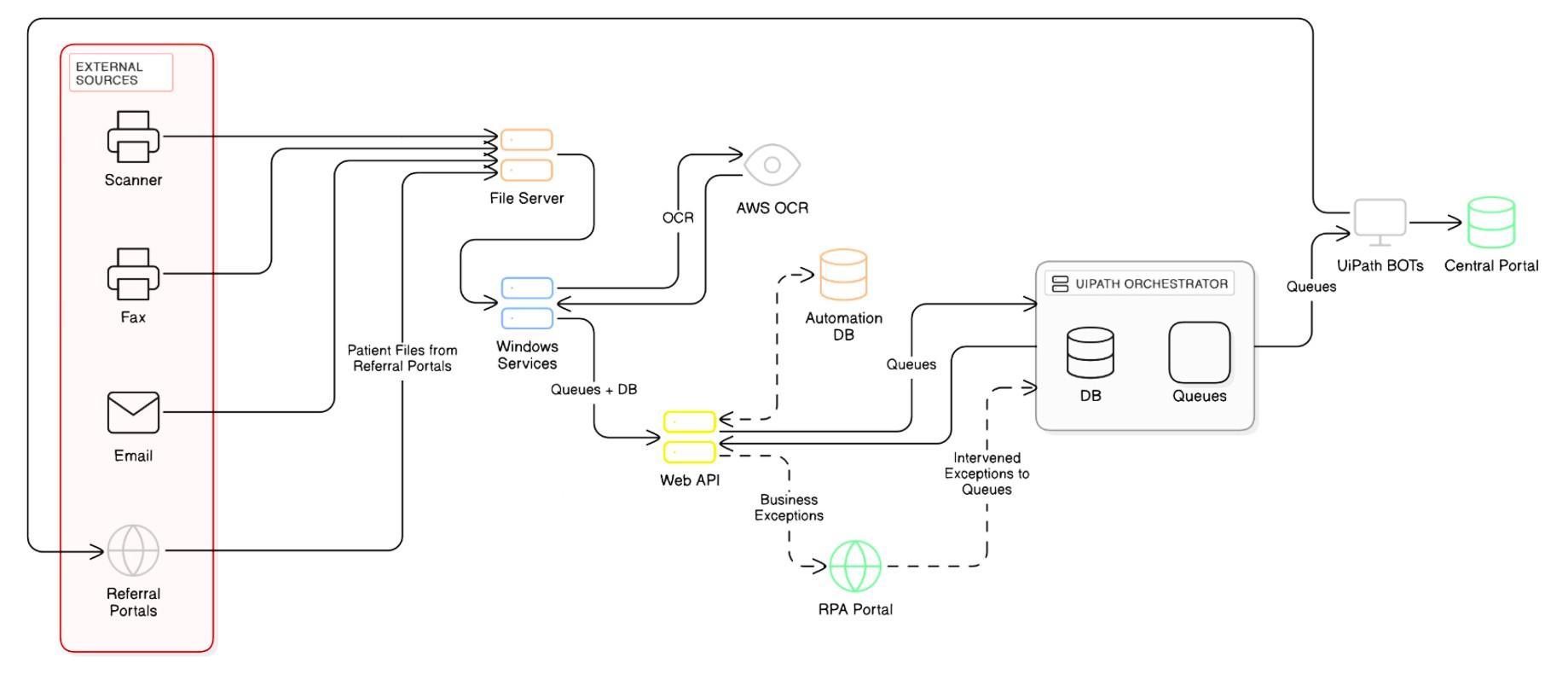
The system establishes a central "landing zone" on a file server. All incoming documents from faxes, emails (via an automated attachment downloader), and manual scans are consolidated here. UiPath RPA bots are deployed to automatically download documents from various third-party referral portals.
Intelligent Document Processing:
A collection of Windows Services continuously monitors the landing zone and processes new files through a multi-step pipeline:
Queue Generation: Documents are picked up and placed into a central processingqueue.
Image & Text Extraction: The system extracts images from PDF files and uses an OCR engine to convert all image-based documents into machine-readable text.
Document Classification: A custom classifier analyzes the content and layout to automatically identify the document type (e.g., Patient Information Sheet, Insurance Card, Clinical Notes).
Data Extraction: Once classified, targeted entity extractors pull key data points from the text, such as patient name, date of birth, policy number, and physician details.
Grouping & Validation: Related documents for a single patient are grouped together. Business rules are applied to validate the extracted data for completeness and accuracy.
Action Determination: Based on the document type and extracted data, the system determines the required downstream action, such as registering a new patient or updating an existing record.
RPA for System Integration:
UiPath bots handle the "last mile" of the process. They take the validated, structured data and perform the necessary actions in downstream systems that lack modern APIs, such as legacy Electronic Health Record (EHR) systems.
Human-in-the-Loop Exception Handling:
For documents where the system has low confidence in its classification or extraction, the item is flagged and routed to a human operator via a dedicated web application. This portal allows staff to quickly review, correct, and complete the processing, ensuring that no document is lost while keeping the pipeline flowing.
Technical Architecture
The platform is built on a microservices-based architecture, ensuring modularity and scalability.
- Core Framework: The backend services and APIs are developed using the .NET Framework (C#), running as a suite of independent Windows Services.
- Web API: A central, load-balanced Web API acts as the nervous system, facilitating communication between the processing services, the UiPath bots, and the front-end portal.
- Robotic Process Automation (RPA): UiPath is used for its powerful Orchestrator, which manages queues and schedules bot execution, and for its robust bots that handle UI-based automation and integration with external portals.
- Database: A Microsoft SQL Server database is used for queue management, storing extracted data, logging, and configuration. A replica database ensures high availability and business continuity.
- Frontend: A modern web application is used for managing business exceptions and providing operational dashboards.
- Infrastructure: The solution is deployed on-premise on Windows Servers and utilizes a shared network file system for document ingestion and archiving.
Result
The implementation of this automated document processing solution yielded significant improvements across the board:
- Drastic Reduction in Manual Effort: Automated over 90% of the manual data entry and document handling tasks, freeing up employees to focus on patient-facing and other high-value activities.
- Improved Data Accuracy: Error rates associated with manual data transcription were reduced by over 95%, leading to cleaner data in downstream systems and fewer billing and patient record issues.
- Accelerated Processing Times: The average time to process a document was reduced from minutes to seconds, significantly shortening the overall turnaround time for patient onboarding and record updates.
- Enhanced Scalability: The system can now process a 3x increase in document volume without requiring additional staff, demonstrating its ability to scale with business growth.
- Strengthened Security and Compliance: The centralized, automated process provides a complete, auditable trail for every document, enhancing HIPAA compliance and data security.
- Significant Cost Savings: The combination of reduced labor costs, increased efficiency, and improved accuracy resulted in a substantial return on investment.
Contact Us
Your response has been saved. Thank you.
We will reach out to you shortly.

Read More
See the latest of our technologies in our blog section.
The Hidden Costs of LLM APIs That Per-Token Pricing Doesn’t Tell You
This article is part of a series on buildi ...
How We Unified Three LLM Providers Behind One Interface
This article is part of a series on buildi ...
Your LLM Prompt Won’t Save You From This
This article is part of a series on buildi ...

© 2026 krtrimaIQ Cognitive Solutions. All Rights Reserved
Email: info@krtrimaiq.ai