Implementation Of A Custom Learning Management System (LMS)
A cloud-native, AI-powered Learning Management System (LMS) that automates training management, enables dynamic course creation, and delivers real-time progress tracking — enhancing engagement, scalability, and organizational efficiency.



Contents
- Objective
- Challenge
- Solution
- Technical Architecture
- Frontend Application
- Backend Application
- Results
Objective
To design and deploy a scalable Learning Management System (LMS) for a leading BPO client having over 300+ employees.
The LMS aimed to streamline employee training, enable seamless course and program management, and provide real-time tracking of learner
progress across roles and departments — all within a secure, configurable environment.
Challenge
Organizations faced several challenges in efficiently managing and monitoring their training initiatives:
- Fragmented training processes made it difficult to track trainee progress and assessment performance.
- Manual course assignment and program creation led to inconsistencies and administrative overhead.
- Teams needed autonomy to manage their own courses and learners while maintaining centralized visibility.
- Security and compliance requirements demanded controlled platform access and data confidentiality.
- Assessments needed to be dynamic, adaptive, and easily maintainable without external dependencies.
Solution
A custom-built LMS was developed to automate and centralize all aspects of the training lifecycle — from course creation to progress tracking — while ensuring scalability, flexibility, and robust data protection. The key features:
Dynamic Department Configuration:
Departments and teams can be added or modified as organizational needs evolve.
Comprehensive Course Management:
Courses can include multiple modules (videos, documents, and assessments) for rich, interactive learning.
Curated Domain-Specific Courses:
The platform also includes ready-to-use, curated courses in specialized domains such as Cybersecurity, designed to accelerate employee upskilling in critical areas.
AI-Powered Question Generator:
Leveraging Generative AI (GenAI) through secure, open-source LLMs hosted on internal GPUs, the system automatically generates assessment questions from course content. Curators can refine these to ensure accuracy and relevance.
In House Code Sandbox:
A fully integrated code sandbox enables users to write and run code instantly within the LMS, supporting multiple programming languages. An embedded AI chatbot assists in understanding logic and algorithms, explains code behavior, and generates relevant snippets or test cases—making coding interactive, intuitive, and self-paced.
Program Creation & Assignment:
Leads can bundle courses into training programs and assign them in bulk using Excel uploads, simplifying administration
Multi-Level Progress Tracking:
Trainees: Access personal progress, results, and attempt history.
Managers: View team performance and completion analytics.
Admins: Monitor organization-wide learning data through intuitive dashboards.
Collaboration & Engagement:
Built-in discussion forums and automated notifications keep trainees engaged and informed throughout their learning journey.
Technical Architecture
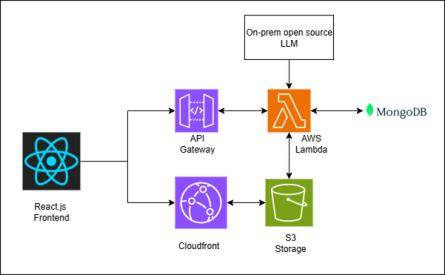
The LMS leverages a cloud-native, serverless architecture built on modern AWS infrastructure to ensure scalability, performance, and security. The frontend, developed in React.js, is hosted on Amazon S3 and distributed globally
via CloudFront, offering responsive, role-based access with secure token-based authentication. The backend, powered by Python (Flask) and MongoDB (PyMongo), runs as serverless APIs on AWS Lambda behind API Gateway, ensuring high availability
and low latency. Course assets and videos are stored securely in S3, while an open-source LLM hosted on GPU servers powers the AI-driven question generation module. System health and performance are monitored through CloudWatch.
Frontend Application
Developed using React.js, the frontend provides a modern, responsive, and intuitive with role-based access tailored for admins, managers, and learners.
Backend Application
Built using Python (Flask) and deployed on AWS Lambda with MongoDB Atlas for structured and flexible data storage.
Results
The LMS implementation resulted in measurable improvements: - Significant reduction in administrative effort through automation and centralized management.
- Improved learner engagement via interactive courses and AI-enhanced assessments.
- Better visibility through real-time dashboards for managers and admins.
- Accelerated upskilling with curated domain-specific content like Cybersecurity.
- Scalable, secure, and future-ready architecture aligned with enterprise growth and compliance needs.
Contact Us
Your response has been saved. Thank you.
We will reach out to you shortly.

Read More
See the latest of our technologies in our blog section.
The Hidden Costs of LLM APIs That Per-Token Pricing Doesn’t Tell You
This article is part of a series on buildi ...
How We Unified Three LLM Providers Behind One Interface
This article is part of a series on buildi ...
Your LLM Prompt Won’t Save You From This
This article is part of a series on buildi ...

© 2026 krtrimaIQ Cognitive Solutions. All Rights Reserved
Email: info@krtrimaiq.ai